Tag Archives: Doctor Who

EDITORIAL: ‘Doctor Who’ has Fallen…to the Surprise of No One

The BBC announced last week that the Doctor Who Christmas Special has been canceled—and so has the show itself.

As part of securing the next phase of the show for future generations, and in line with the BBC’s Charter and Agreement requirements, the BBC will put Doctor Who out to competitive tender this year. Doctor Who remains an important part of the BBC and this tender underpins the BBC’s continued commitment to Doctor Who ensuring audiences will enjoy the show for years to come.

Once again, the famed British institution is off the air. The last time was in 1989 during the tenure of Sylvester McCoy as the Seventh Doctor.

But the circumstances couldn’t be more different.

Classic Who suffered a slow death due to sabotage by higher-ups at BBC, particularly Michael Grade, the then-current Controller of BBC, who had lost faith in the show. Grade himself put the show on an 18-month hiatus in the mid-eighties, calling it “‘rubbish,’ too violent, and a poor use of the license fee,” viewing it as inferior to the likes of Star Wars and E.T. He was also openly hostile to the Sixth Doctor actor, Colin Baker, and sought to have him removed. In other words, the series had no advocate at the network.

While Grade left in 1987, his plan came to fruition two years later, leaving the series in limbo for 16 years. Fan enthusiasm continued via conventions, but aside from an ill-fated TV movie starring Paul McGann in 1996 and a Red Nose Day comedy special called “The Curse of Fatal Death” in 1999, the franchise remained dormant until it was revived by Russell T Davies in 2005. Thus began Nu Who, which exploded in popularity, spawning several spinoffs, thanks largely to the iconic tenures of David Tenant and Matt Smith as the Tenth and Eleventh Doctors, respectively. The series found a sweet spot between adhering to the past and appealing to modern sensibilities.

Steven Moffat took over in season five, and while his run garnered some criticism during Peter Capaldi’s tenure as the 12th Doctor, he was an excellent choice to succeed Davies as showrunner. Moffat wrote the most popular and acclaimed episodes of the first four seasons, such as the iconic “Blink.” He had proven himself an excellent writer and visionary.

The same couldn’t be said for his successor, Chris Chibnall. He wrote a few episodes that were average, at best, and a handful of scripts for the DW spinoff Torchwood, so his selection left Whovians scratching their heads. He made sweeping reforms to the show, replacing most of the crew and writers, but the most shocking of all was having the Doctor regenerate into a woman. This unfortunately numbered 13th Doctor was played by Jodie Whitaker, and while early episodes got decent ratings out of curiosity and novelty, they slowly tapered off during her tenure. There was also a massive shift in the storytelling. While cracks began to form here and there during Capaldi’s time in the TARDIS, they erupted into chasms under Chibnall. The show became more ideological, alienating many fans with its ham-fisted dialogue and stories. No classic Who foes returned until a single Dalek in the New Year’s Day special “Resolution.” For many fans, the show was unrecognizable aside from the TARDIS exterior.

However, the greatest injury inflicted by Chibnall came with the next season’s infamous finale, “The Timeless Children,” in which the Doctor’s mysterious past is fully revealed with a franchise-breaking retcon. The Doctor’s archenemy, the Master, says the Doctor is not a Time Lord or even a Gallifreyan. No, he was an interdimensional being—who appeared in the form of a little black girl—discovered by a female Gallifreyan scientist. Through horrendous experiments, this scientist forced this being to die and regenerate multiple times until she learned the secrets of this process bestowed it to all Gallifreyans, which led to them building one of the most advanced civilizations in the universe. Not only did this fly in the face of what had been established before—even in the previous seasons of the revived series—it retroactively ruined Classic Who and undermined any suspense in future stories, because the Doctor was made functionally immortal with an infinite number of regenerations. What was once done as jokes in “The Curse of Fatal Death”—female Doctor and flippant regenerations—had now been made “canon.” It was a bridge too far for most Whovians, and the ratings plummeted.

The worst part is this story could’ve worked if not for the Timeless Child being the Doctor. It’s been established since Classic Who that the Doctor is a rebel who had good reason to dislike his fellow Time Lords. They’d become haughty and elitist. Saying they’d acquired their greatest ability by exploiting and torturing another sentient being would fit perfectly. If Chibnall wanted the twist of the Timeless Child being an established character, it would’ve made more sense for it to be the Master. It would explain why he hated the Time Lords and why the Time Lords hated him and also account for the Master’s bizarre abilities and his penchant for cheating normal Gallifreyan limitations. The Time Lords had a long history of reviving him in moments of desperation when they needed a warrior or a leader. If he was this being, that would make sense. Indeed, many fans hoped this revelation would be hand-waved away as a lie by the Master. As it stands, it asks too many questions. How did the Doctor not know he wasn’t a Time Lord? Was his memory erased? How often? How was this information kept from him and everyone he knew for untold eons? I could go on.

Whitaker’s Doctor spent the usual three seasons in the TARDIS, but her replacement was kept secret until her regeneration—revealing it was David Tenant. On the heels of that was the return of Davies as showrunner. I’m sure the BBC saw this as an appeal to fans to return, but it reeked of desperation. Bringing Tenant back was such a gimmick. This was also when Disney agreed to fund the show. The plan was to do a series of specials between seasons, which aired on Disney+. That gave some pause for concern, because Disney had damaged its reputation with its media and parks, to say the least. Even so, the ploy with Tenant did work—only for the character to be disrespected and lectured by his former Companion, Donna Noble. The run of specials culminated with the 14th Doctor “bi-generating”—one of the dumbest retcons in the franchise’s history—into Ncuti Gatwa’s 15th Doctor. The whole concept screamed, “Have your cake and eat it, too,” since the show would now follow Gatwa but Tenant’s 14th Doctor could always come back without time travel shenanigans.

From there, the show moved to Disney+, and while Disney’s money could be seen on screen, the scripts were abysmal. Davies not only didn’t repair the damage inflicted by his friend Chibnall, he poured salt into the wounds and inflicted more. The show became, for lack of a better term, needlessly gayer and even more agenda-driven. More viewers jumped ship with each episode. By Gatwa’s second season, Doctor Who had worse ratings than when it was first canceled in 1989. Gatwa, presumably, saw the writing on the wall and prematurely exited the show a season early, ending his run—and, it seems, the show itself—with the strangest and most controversial regeneration in franchise history: the Doctor became Rose Tyler. This took the gimmickiness of Tenant’s return and cranked it to 16 (just to be on brand).

All of this to say, many Whovians, myself included, saw this coming years ago. We abandoned the show at one point of another and watched as it spiraled into irrelevance. What was once a British institution, the Star Trek of the UK, is now a shell of its former self. The Doctor was a coveted role for any British actor, but not anymore. Unlike in 1989, this downfall could’ve been prevented. If Chibnall and Davies had simply listened to the audience and refrained from self-indulgent storytelling, a new Christmas special would be in post-production right now with a new season being filmed. Instead, the final episode ends on a baffling and even infuriating cliffhanger.

Can the franchise be saved? How? Some have suggested backtracking to when Capaldi regenerated and restarting with a new 13th Doctor, supplanting everything that has come from the Chibnall era and beyond. More likely, though, a full-fledged reboot may be in order. But that’s assuming there is still any interest in Doctor Who at this point. The series may have exhausted its regenerations.

Franchises like Star Trek and Star Wars should look at the fall of Doctor Who as a cautionary tale—or more accurately, as a warning. If they don’t change course and stop hemorrhaging fans, they, too, will vanish from the annals of pop culture.

“Have you ever heard the tragedy of Doctor Who the clever?”
Re-Enabling Davros: A Classic Case of Missing the Point

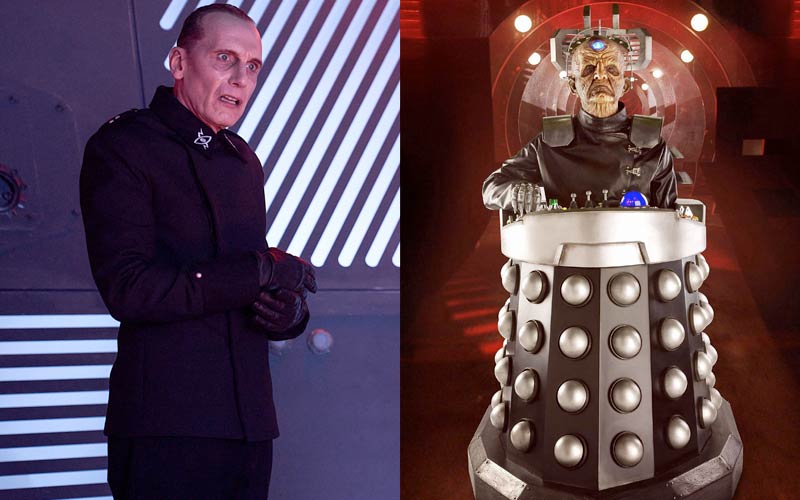
Julian Bleach as Davros in 2023 (left) and 2008 (right).

While I still consider myself a Whovian, I haven’t watched “Nu Who” for several years. To put it succinctly, Chris Chibnall was Doctor Who’s worst showrunner ever, and Jodie Whitaker’s 13th Doctor has proven to be as unlucky as her numbering. That’s why I had some hope when Russell T Davies, the man who successfully revived the franchise in 2007, was announced to be returning, although I found the return of David Tennant to be a desperate gimmick to bait the show’s lost audience into coming back. Still, I was willing to give it a chance.

Not anymore.

The 2023 Children in Need special.

Recently, a Children in Need special was published on YouTube that shows an able-bodied and unscarred Davros, the iconic creator of the evil Daleks. While I thought the special’s comedic tone toward the “genesis of the Daleks” undermined the threat of the Doctor’s archenemies (a whole blog unto itself), fans, including myself, assumed Davros looked like this because it was a prequel, but Davies revealed this will be Davros’s look going forward.

In his own words:

We had long conversations about bringing Davros back, because he’s a fantastic character. Time and society and culture and taste have moved on, and there’s a problem with the old Davros: he’s a wheelchair user who is evil. I had problems with that. A lot of us on the production team did too, associating disability with evil. Trust me, there’s a very long tradition of this.

I’m not blaming people in the past at all, but the world changes. And when the world changes, Doctor Who has to change as well. So we made the choice to bring back Davros without the facial scarring and without the wheelchair – or his support unit, which functions as a wheelchair.

I say, this is how we see Davros now. This is what he looks like. This is 2023. This is our lens. This is our eye. Things used to be black and white; they’re not anymore. Davros used to look like that, and now he looks like this. We are absolutely standing by that.

Ignore Davies’ hypocrisy of create a villain who was motivated to make Cybermen so he could develop technology to get him out of a wheelchair. I’m here to show that he is missing the point.

It’s well-documented that the Daleks were inspired by the Nazis. These pseudo-cyborgs were created in the 1960s by filmmakers who still had fresh memories of World War II. Davros first appeared in 1975’s “Genesis of the Daleks,” which was written by Dalek creator Terry Nation. In keeping with the Nazi inspiration, Davros bears mannerisms often associated with Hitler and the SS. (In fact, he reminds me of Peter Sellers’s Dr. Strangelove, only not satirical). He is blind and disabled due to constant eugenic experiments he, in true mad scientist fashion, conducted on himself. This eventually led to the creation of the Daleks. In other words, Davros being confined to a wheelchair is a consequence of his attempts to make a master race.

The problem is Davies is concerned with optics. The image of a villain in a wheelchair, he fears, will make the audience assume all disabled people are evil. This ignores the clear origins of and creator intentions for Davros. His disability was self-inflicted and motivated by racial supremacy. So, by curing Davros to avoid “ableism,” Davies is removing the consequences of a far greater evil and disrespecting the creators who came before him. He has made a Nazi pastiche look more like the so-called “Aryan ideal.” Doesn’t this validate that evil ideology? Isn’t it, in some bizarre way, actually ableism?

If Davros must be able-bodied to avoid portraying disabled people as evil, then other iconic villains must be changed to remain consistent. Villains like:

  • Doctor Doom, who has a disfigured face.
  • The Weird Sisters of Macbeth, who are blind.
  • Freddy Krueger from A Nightmare on Elm Street, who is a burn victim.
  • Baron Harkonnen from Dune, who is morbidly obese.
  • Darth Vader, who is a burn victim, an amputee, and an asthmatic.

In all of these cases, these disabilities are the consequences of their evil actions and often motivate the evils they are now committing. We fear them because they’re stark representations of the true face of evil and its consequences (and also the fear of the unnatural or abnormal, but that’s a blog for another day). Removing these disabilities fundamentally alters the characters to the point that they are no longer those characters. It also implies that only “perfect” or “able-bodied” people can be evil, trading one prejudice for another.

There are plenty of counterexamples with disabled heroes. Characters like Marvel’s Daredevil (blind), Zatoichi the blind swordsman, Jonah Hex (disfigured face), and even Spawn (burn victim). Characters like them either use or overcome their disabilities; their disabilities motivate them to be heroic. In other words, it boils down to virtue vs. vice. Contrary to popular belief, these are not exclusive to particular groups. As a Christian, I believe “all have sinned and fallen short of the glory of God” (Romans 3:23), which means all people are on equal ground before the Almighty. Sadly, we will in times that deny this reality. Instead of understanding the deeper motivations and philosophies at work in disabled villains (and heroes), creators look only at the surface and/or see them as representative of entire groups of people instead of as representatives of themselves. It’s the definition of “shallow.”

All that to say, I won’t be watching the new Doctor Who anytime soon.

Check out the latest episode of my podcast, where I’m joined by my friend and fellow writer Nick Hayden. Enjoy!

Hello, kaiju lovers!

In the latest episode of the “Kong Quest” (which is finally mentioned by name on the air!), Nathan is joined once again by author and “Golden Ticket Tourist” Nick Hayden of the Derailed Trains of Thought podcast to discuss the wacky but fun King Kong Escapes. Like with the 1933 film, this is Nick’s first time seeing this 1967 Toho classic, which was the second (and sadly last) of Toho’s Kong films, as it was made in the last year they held the rights to the Eighth Wonder. This is a first for the show as it’s the first tokusatsu film directed by the great Ishiro Honda covered on the podcast. It’s a crazy nexus of ideas borrowed from other productions and some that seemed to anticipate others. For one thing, its villain, Dr. Who, is both a derivation and a precursor to the famous British TV series! Nathan and Nick also note some funny connections to Rankin-Bass’ classic holiday special Rudolph the Red-Nosed Reindeer given that they collaborated with Toho on this live-action cartoon.

The Toku Topic is how Toho’s Japanese-American co-productions paralleled Japan-America relations.

Stay tuned after the credits for a Marvel-style stinger and an important announcement.

Timestamps:
Intro: 0:00-3:25
Entertaining Info Dump: 3:25-11:25
Toku Talk: 11:25-52:57
Toku Topic: 52:57-1:19:25
Outro: 1:19:25-1:24:50
Stinger:  1:24:50-end

© 2019 Moonlighting Ninjas Media

Bibliography/Further Reading:

Do Fans Always Know What’s Best?

Image courtesy of Lean Pathways.

In 2015, my friends Nick Hayden and Tim Deal produced an episode of their podcast, Derailed Trains of Thought, about who “owns” a story. This included the writer, the audience, and the publisher. That planted a kernel in my head that has recently bloomed. It has to do with whether the fans of something—particularly in the creative fields—know what’s best for what they like.

The most immediate example I can think of is taken from this video on Linkin Park (produced before the sad death of frontman Chester Bennington). The host mentions that the band, which has experimented with different sounds in all of their albums, was constantly being asked by their fans if they’d make something like their first album, “Hybrid Theory,” again. This prompted an angry response from Bennington, who more or less said that was a great album but that the band was working on new things now.

Honestly, I sympathized with Bennington. It can be annoying when you’re trying new things but your fanbase just wants you to keep making all the same stuff. If I had readers coming up to me, saying, “Why don’t you write more books like Pandora’s Box?” I’d be vexed. I decided a long time ago that I didn’t want to be a writer who got pigeonholed, as many have been. It’s why, believe it or not, many authors use pseudonyms if they write something outside their usual genre. The publisher thinks that readers won’t buy the book because it isn’t the same stuff they’re used to seeing from that author. Now, some authors are such huge names they can get away with it now (like, say, Stephen King), but they’re exceptions. It is something I’ve considered doing, though. I have some ideas so divergent, seeing my name on the cover might disinterest readers.

The problem is fans can like something so much they just want to keep getting more of the same. But no matter how much an artist tries to refine it, it gets stale. Instead of branching out and taking risks, they play it safe. That might bring them money, but it won’t help them grow as artists. Changing things up, though, could scare their fans away because it isn’t the same. People like familiarity and often oppose something new. Just talk to any Whovian (Doctor Who fan) whenever a new Doctor or Companion is introduced. Many won’t like them at first, if at all.

Am I saying artists shouldn’t listen to their fans? No, not at all. There are times when an artist could stray so far off the beaten path he produces something that ceases to resemble what he created that made his fans like him in the first place. Or it’s just plain bad. Believe me, I’ve often said that I could write a better script than most people in Hollywood when lamenting the dumb decisions made in films and TV shows I like.

The other problem, though, is the creator may hear what fans want and try to give it to them, but they end up not liking it. Now, this could be because the creators misunderstood what the fans wanted (i.e. the demand that DC/Warner Bros. make a Superman movie where he “fights” a villain, which resulted in the oft-criticized Man of Steel), but more often, I think, fans realize that what they wanted wasn’t what was best.

In the end (hey, an unintentional Linkin Park reference!), it boils down to trust. Fans need to trust creators to know what they’re doing and that the creators are taking their thoughts/ideas into consideration. Creators need to trust their storytelling instincts and abilities and not be people pleasers. It’s impossible to make everyone happy. Even the best-reviewed films have detractors. Even literary classics have readers who don’t like them. That’s why my mantra has always been, “Story is king.” Whatever is the right thing to do for the story, whether that’s what the fans or creator want, is what’s best.

Do you think fans or creators know what’s best for stories? Why? What are some good and bad examples of both?

Jodie Whittaker, Doctor Who, and Double Standards

It’s been nearly two weeks since Jodie Whittaker was announced as the 13th Doctor on Doctor Who (one of my favorite shows), and the Internet has been on fire ever since.

I added my voice to this fire by speaking out against this casting and declaring that I was done watching the show. This led to arguments online and offline full of ad hominems aimed at me. As far as I care, if someone has to resort to such tactics, they automatically lose the debate regardless of how good their points are. I was accused of sexism and misogyny and told I would scare away any and all potential dates by saying what I was saying (in other words, I’d never get a girlfriend).

I kept quiet after a day or two, but now I’ll lay out what I think are nuanced reasons for disliking the BBC’s decision. I won’t repeat what I said in a 2014 blog (which has now garnered me some derision). This isn’t as simple as, “The Doctor is a woman, therefore I hate it!”

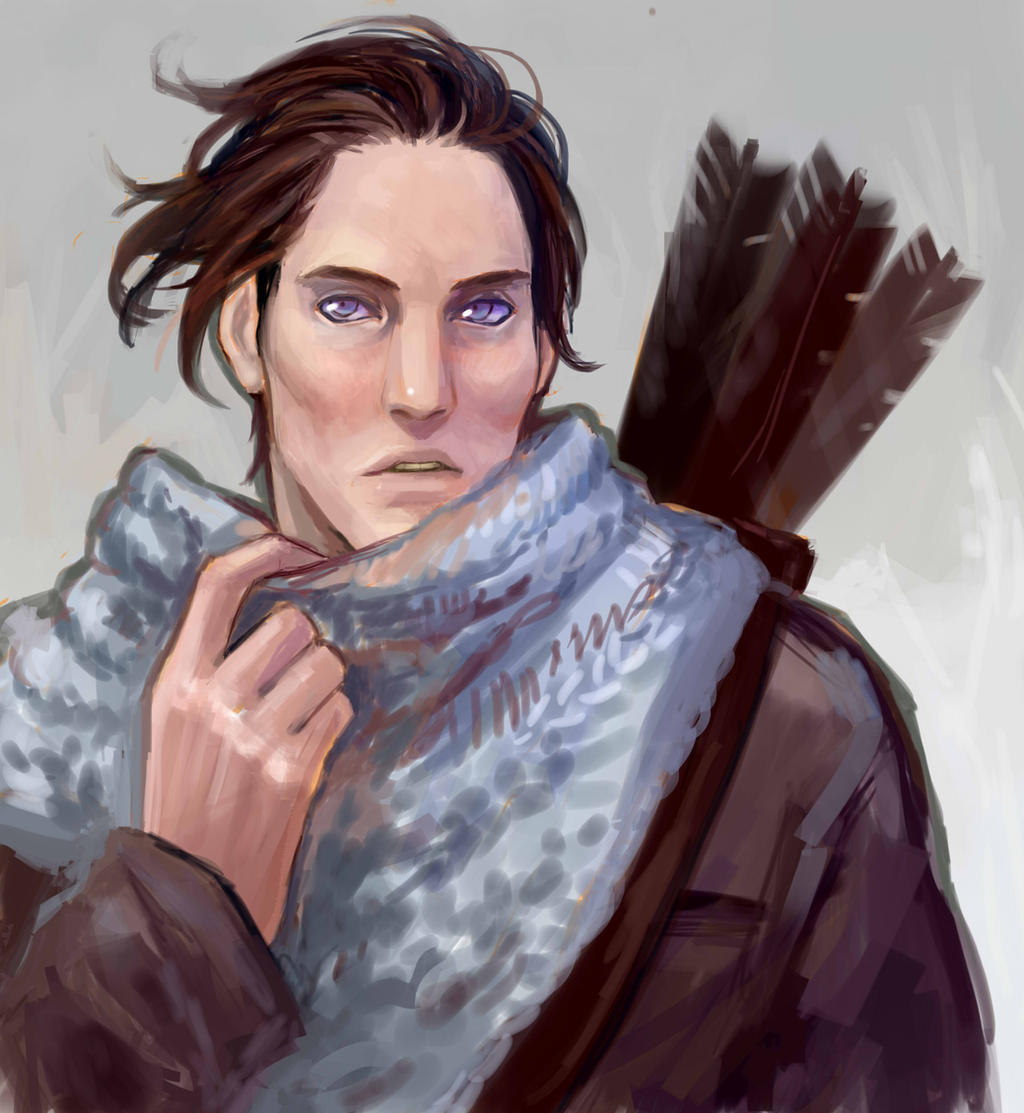
Artwork by Zapekanka. (http://zapekanka.deviantart.com/)

Let me begin by asking my female readers this:

If you heard Katniss Everdeen from The Hunger Games was being transformed into a boy and recast with a male actor, would that upset you?

If you said yes, then you may understand why I don’t like the idea of female Doctor.

It’s perfectly plausible that it could happen. Given the Capital’s penchant for genetic manipulation, vanity, and cruelty, it’s quite reasonable they could force a sex change operation on Katniss. But neither Suzanne Collins (the original author) nor Lionsgate ever did that. It would’ve made things needlessly complicated and messy. If they wanted to tackle gender issues within that universe, they’d have been better off creating a new character.

I say this because that’s the sort of arguments I hear for making the Doctor a woman. Recent additions in the Who mythos—most notably his archenemy, the Master, regenerating into a woman—paved the way for this happening (despite the fact that if Gallifreyans could do this, their society would look vastly different, but I digress). Others say science fiction has always tackled the issues of the day, and issues of gender identity are certainly hot topics now. But as I said above, taking a main character who’s been established as being male (or female) and forcing a gender swap just to make a social commentary isn’t good storytelling. It just makes the character a means to an end and doesn’t do the character or the audience any favors.

What saddens me is I’m pretty sure that if a female character was changed to a male in a similar fashion, there would be huge backlash and it would be considered legitimate. However, most people who criticize the decision to make the Doctor a woman are met with nothing but trolling and accusations. That, True Believers, could be extrapolated to be a double standard.

Would I object to a rebooted Doctor Who with a new continuity and new characters that included a female Doctor? No. That’s worked for other franchises like Battlestar Galactica with a female Starbuck. How about a spin-off with a Doctor-esque Time Lady? That’d be cool. Heck, 5th Doctor actor Peter Davison even suggested that a few years ago while also saying the Doctor shouldn’t be a woman. (His opinion hasn’t changed, and he’s been criticized for it).

Another argument in favor of this decision is it’ll give little girls a Doctor for a role model. While I’ve argued that representation is overrated and people can relate to a well-written character regardless of demographics, the fact remains that people still gravitate toward characters who look like them. But what about the little boys who are about to see their hero morph into a woman? Wouldn’t that be a shock? Might they ask awkward questions of their parents? It’ll already be difficult adjusting to a new Doctor; this’ll only make it harder. They might even stop watching.

Admittedly, this is all pure theory. I have no way of knowing what will happen. Regardless, as much as it pains me, I don’t plan to watch the series beyond the Christmas special. I find this decision to be a desperate gimmick motivated by political correctness aimed to please a vocal group of fans who don’t speak for the whole fanbase.

Do you agree or disagree with me? Why? What do you think of this decision? (Please keep your comments civil).

Cheating Sleep

“I’ll sleep when I’m dead!”

That’s a sentiment I’ve heard often in the last few years. It’s spoken by either workaholics or braggarts who pride themselves on being able to function on little or no sleep. The sad thing is this is usually seen as a good thing, especially in the United States, which has a culture that idolizes work. Honestly, in many cases, it’s nothing more than disguised greed.

There was a recent episode of Doctor Who entitled “Sleep No More” that touched on this. The Doctor and his Companion, Clara, come to a space station whose crew was conducting sleep experiments, but the station has now gone dark, most of the crew killed. The Doctor discovers that the crew was developing a means to allow humans to get through the day with less than an hour of sleep so as to increase productivity. He was angered by this, accusing them of trying to “cheat nature” in their arrogance. Then, in true Doctor Who fashion, the “sleep dust” (the crust often found in tear ducts after much sleep) all collected into murderous monsters thanks to that sleep-cheating process.

What intrigued me about this episode is its theme was something I’d been contemplating for a while at the time. Call me crazy, but I think God designed humans to require sleep as a means of keeping them humble. If they were able to function without it, they would either become lazy (or lazier) or, more likely, they would get to the same point they did with the Tower of Babel, looking upon their accomplishments and thinking themselves gods. (The sad thing is there are people now who, in one form or another, think this already).

However, research tells us that humans need at least seven to eight hours of sleep a night. Think about that: that’s a third of a day. Some look at that and, much like those scientists in that Doctor Who episode, say that’s a waste. What they don’t realize is that it’s part of an ideal balance for one’s life. For eight hours you sleep, and for eight hours you work. That leaves eight hours to spend doing whatever you want. Everything is equal. But as is typical with human beings, they want to tip that balance, and that often requires eating into sleep time. Heck, there’s at least one entire industry built around cheating sleep: energy drinks. From Red Bull to Monster to 5-Hour Energy, their marketing centers around giving you a boost to do more. That could be doing more work so you could have a bigger paycheck or staying up late playing video games. (These are just two examples). Unfortunately, as I’ve observed myself, people become addicted to energy drinks to the point that they can’t function without them. If they don’t have one, they crash, and they crash hard. Then they run the risk of drinking too many and overstimulating their hearts until they explode (their hearts, I mean. I doubt energy drinks make people explode). 😛

I’m not saying one should never use energy drinks or that one can always get eight hours of sleep a night. For example, parents with newborns will lose sleep because they must care for the baby. Some people also have health issues that can cause insomnia. Stuff like that aside, it’s best not to make a habit to lose sleep. It will catch up to you. Trust me, I know.

What do you think? Would humanity become more arrogant if it could function with little or no sleep? What would happen? Do you try to “cheat nature” by avoiding sleep? How has that worked out for you?

My (Overdue) Alma-Con Report

I’m getting into a bad habit of not blogging in a timely fashion. Or on time. My friend/co-author Eric Anderson definitely kicked my butt on this one since he blogged about it two weeks ago! Hence why you’re getting this and another blog today.

Anyway, Eric asked me to join him at Alma-Con, a small but growing anime/fandom convention held at Alma College in Alma, Michigan (seeing a pattern here?) 😛 He purchased a table to promote his nerd/geek outreach ministry, Nerd Chapel, but he was selling copies of our devotional book, 42: Discovering Faith Through Fandom, so he wanted me present. He’d asked me to attend other cons with him, but I wasn’t able to make it, so this was exciting.

What follows will be similar to write Eric wrote about, but we did have some different experiences.

I arrived an hour or so after the con began. The vendors’ hall—at least the one we were in—was only open for a few more hours. Not much happened while I was there except we met a panelist (whose name escapes me) who saw the title of our book and said, “That sounds like something Vic would say.”

Quoting Korath from Guardians of the Galaxy, I said, “Who?”

He explained he was friends with Vic Mignogna, a popular anime voice actor (among other things). I was surprised to (re)learn that Vic was a Christian and went to panels to discuss faith in anime. This gentleman, Eric and I learned, was a practitioner of sect of Buddhism strangely similar to Christianity. He shared his story of how he came to this faith. He said he’d come back later to talk with us, but sadly, he never came. (If you’re reading this, please contact Eric and/or I!)

Eric (right) and I (left) as Martian Manhunter and Superman, respectively.

Saturday was the long day. Eric and I cosplayed. He was Martian Manhunter and I was Superman. I enjoyed wearing the costume because I’ve gotten into better shape since the last time I wore it, and given that it’s, well, spandex, I was glad for that. The most interesting stories that came from that day was meeting a young man who was a member of the “Church of Satan,” yet they didn’t worship Satan or even believe he existed, which was interesting. While Eric was gone, though, a belligerent cosplayer dressed as some blue-haired anime mad scientist (or something) came over and proceeded to insult me and denigrate Christianity while in character. I wasn’t sure what to think of it, so I just ran with it and smiled.

Two Alma College students were kind enough to give Eric and I their lunches from their meal plans, so we got some food from the college diner, Joe’s.

The Alma College students who kindly offered their lunches to us.

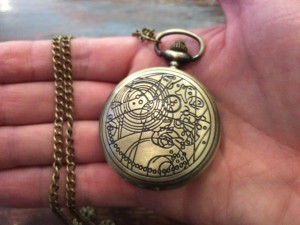
I, too, wandered around. It was then I learned one of my few gripes with the con: the buildings it was held in were too far apart. It was a Michigan winter, so obviously it was cold, and tights provide little protection against such weather. I did go check out the other artists and vendors, and as usual, I had to refrain from buying a bunch of stuff (including a book self-publishing comic books). I did purchase a replica of the fob watch used by David Tenant in two episodes of Doctor Who, though. It went great with my cosplay.

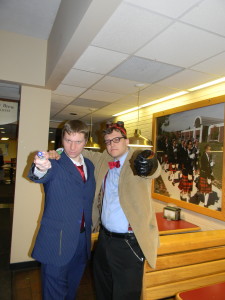
Speaking of which, once the vendor hall closed for the day, I changed into my 10th Doctor cosplay. Eric and I got dinner at Joe’s, where we met a fellow Whovian/cosplayer.

IMG_3482
The fob watch I bought for my 10th Doctor cosplay.

Me with a fellow Whovian cosplayer.

We then went to see MacSith, a play performed by a traveling theatre troupe from Chicago. It is Shakespeare’s MacBeth if it took place in the Star Wars universe. It. Was. FANTASTIC! It combined two of my favorite things—Shakespeare and Star Wars—in a seamless and wonderful fashion. Thankfully, I don’t have to describe it all to you since, unlike most theatre, they allowed (non-flash) photography and video to be taken. The costumes, the fight choreography, the little Star Wars flavoring to the original dialogue—it was amazing.

Sadly, I couldn’t say the same for the next event Eric and I attended. It was billed as a “masquerade ball.” Since we’ve had ballroom dance training, we were interested in going to this unlike the rave that was held the night before. The con program even said there was a dress code, and the organizers reserved the right to turn people away if they didn’t abide by it (hence my 10th Doctor cosplay). But when we arrived, this “ball” was essentially a rave with fancier clothes and no glow sticks. Seriously. The attendees broke off into a few cliques like this was a school cafeteria and gyrate to the music…sometimes. The liveliest they got was during a line dance I didn’t know. I asked the DJs to play “Tank!” by the Seatbelts, which is the theme song to Cowboy Bebop, since the Pokemon theme song was played earlier—and almost nobody got excited! “Haven’t they seen this show?” I wondered. The kicker, though, was every girl Eric and I asked to dance either didn’t know how or flat-out turned us down. The best I could get was doing a line dance when “Time Warp” from The Rocky Horror Picture Show played, and even then people didn’t seem that excited and even fewer knew the line dance, so I wasn’t able to learn it. Eric and I left after an hour.

Seriously, Alma-Con. If you say it’s a “masquerade ball,” make it a masquerade ball! You have a swing dance group on campus: try appealing to them a bit better to run this event.

::steps down from soapbox::

The next day was gonna feature our big event: the Nerd Chapel worship service…

…and nobody came. L

So Eric and I shared communion and I recorded his sermon (which, come to think of it, I need to send to him to post online…).

I left soon afterward so I could return in time to go to work that evening.

All in all, not a bad weekend.

My Full Tri-Con 2015 Report

How many times can I apologize for missing “blog days” before you, dear readers, dump me like a bad boyfriend? It’s been a few weeks since I posted a video detailing some of my experiences at Tri-Con 2015 in Evansville, Indiana, and I promised a full blog on it, which only now am I writing.

I’ll say it, anyway: Sorry for the delay.

“And now for something completely different.”

Day One
Tri-Con got off to a rough start. I thought the vendor hall opened at noon, but it was gonna take me five hours to drive there. It didn’t help that I worked late the night before at my day job. So, I bought two bottles of 5-Hour Energy to get me through the day. I took one just before leaving and one more just before I arrived. Complicating matters, since both the CD player and tape player in Silver Sable (my car) weren’t working, I created a makeshift stereo system using my iPhone and a portable speaker. This disallowed me from using my phone’s GPS because of the battery drain, so I had to print out directions. It made things a bit more annoying.

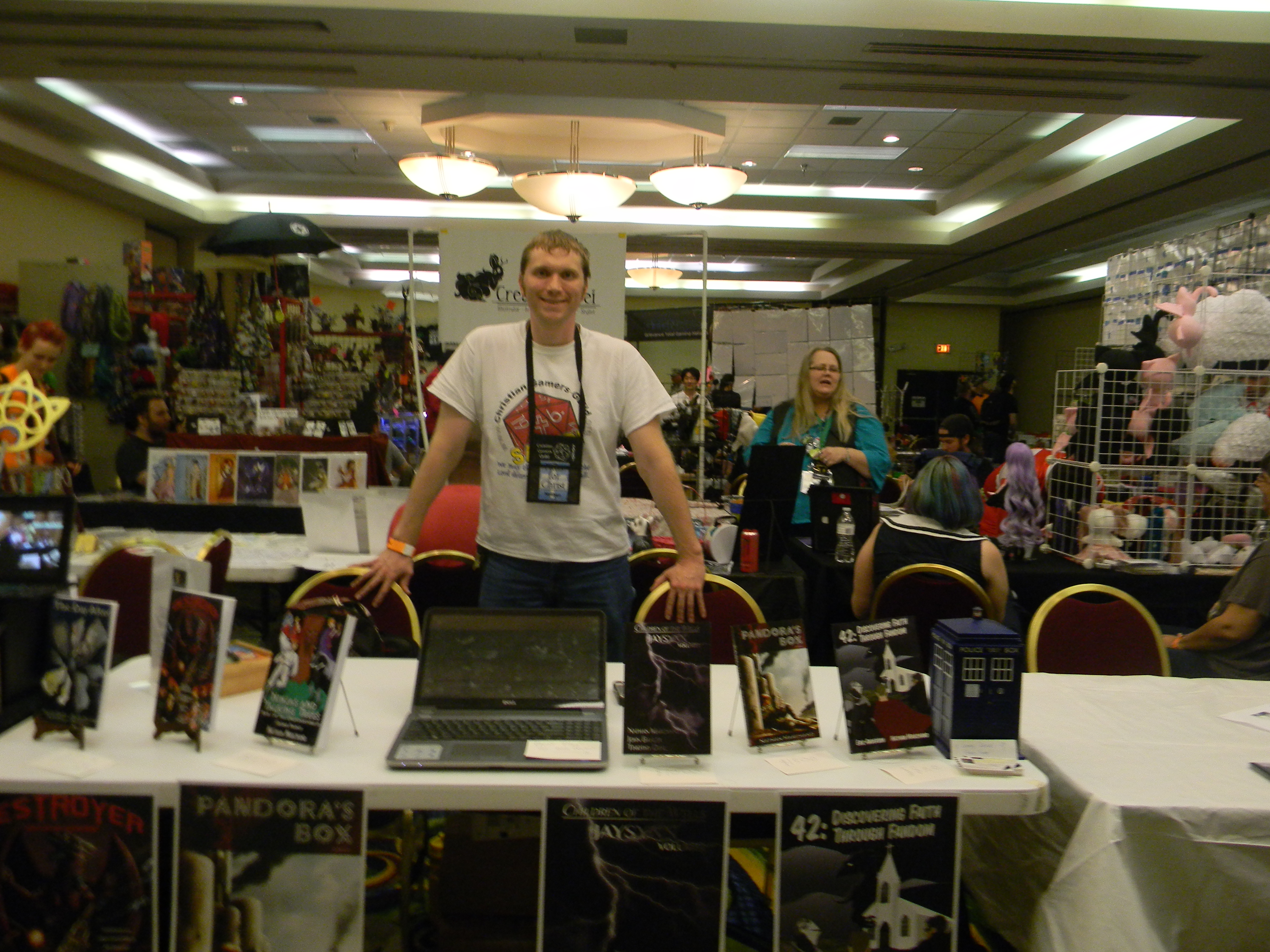
My table.
My table.

After a harrowingly long drive, I arrived at the Holiday Inn where the con was being held. I was surprised to learn that the vendor hall opened at 2pm, and thanks to slipping from eastern time to central time (barely), I ended up being early instead of late. (I think. My brain was buzzing more than a beehive at the time). I set up shop and introduced myself to my neighbors, which included chiptunes artist Professor ShyGuy and anime crafts company Sweets Haven. I was glad we all got along since the vendor hall was cramped. The aisles were narrow and the vendors were practically sitting back-to-back.

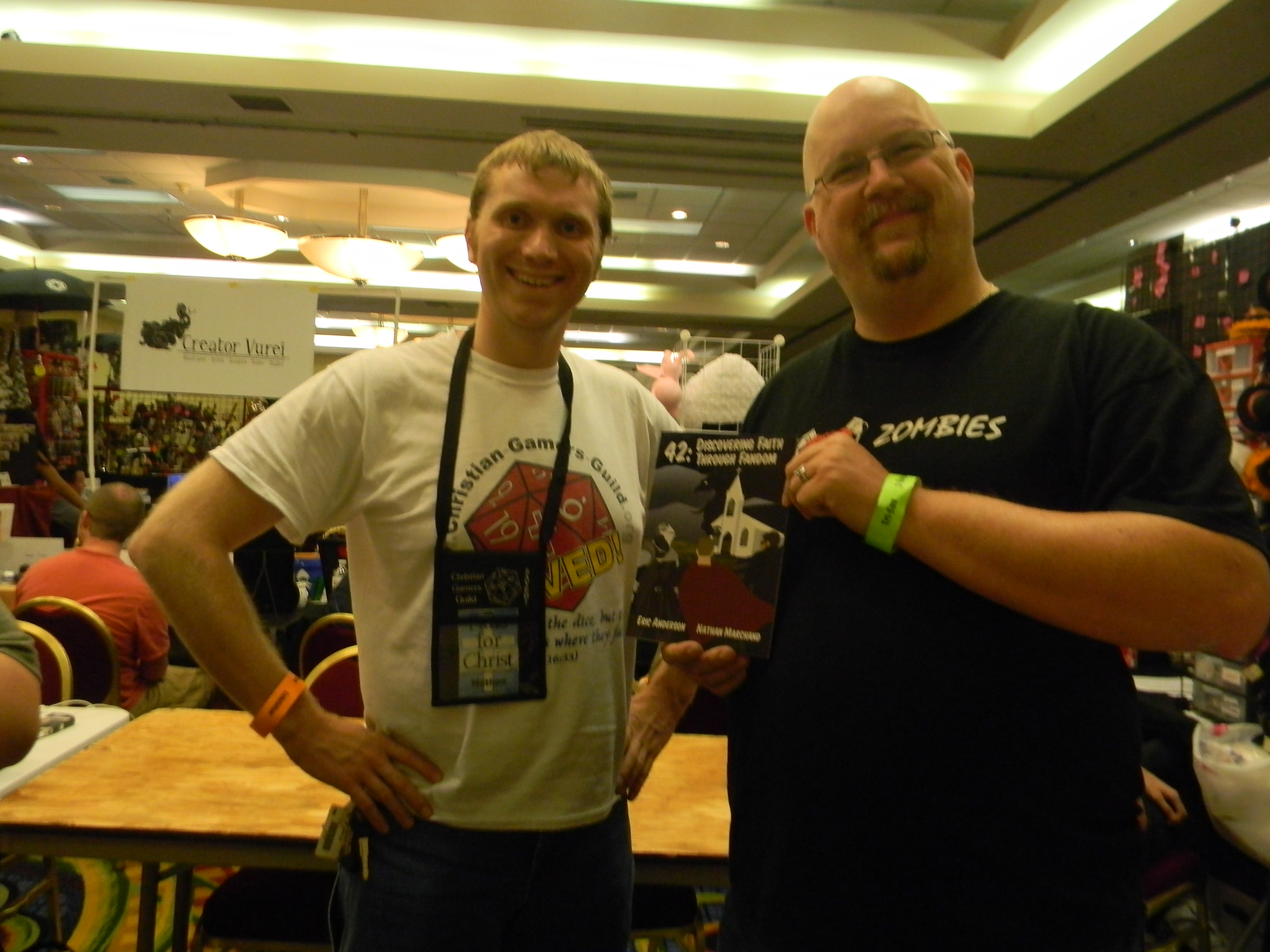
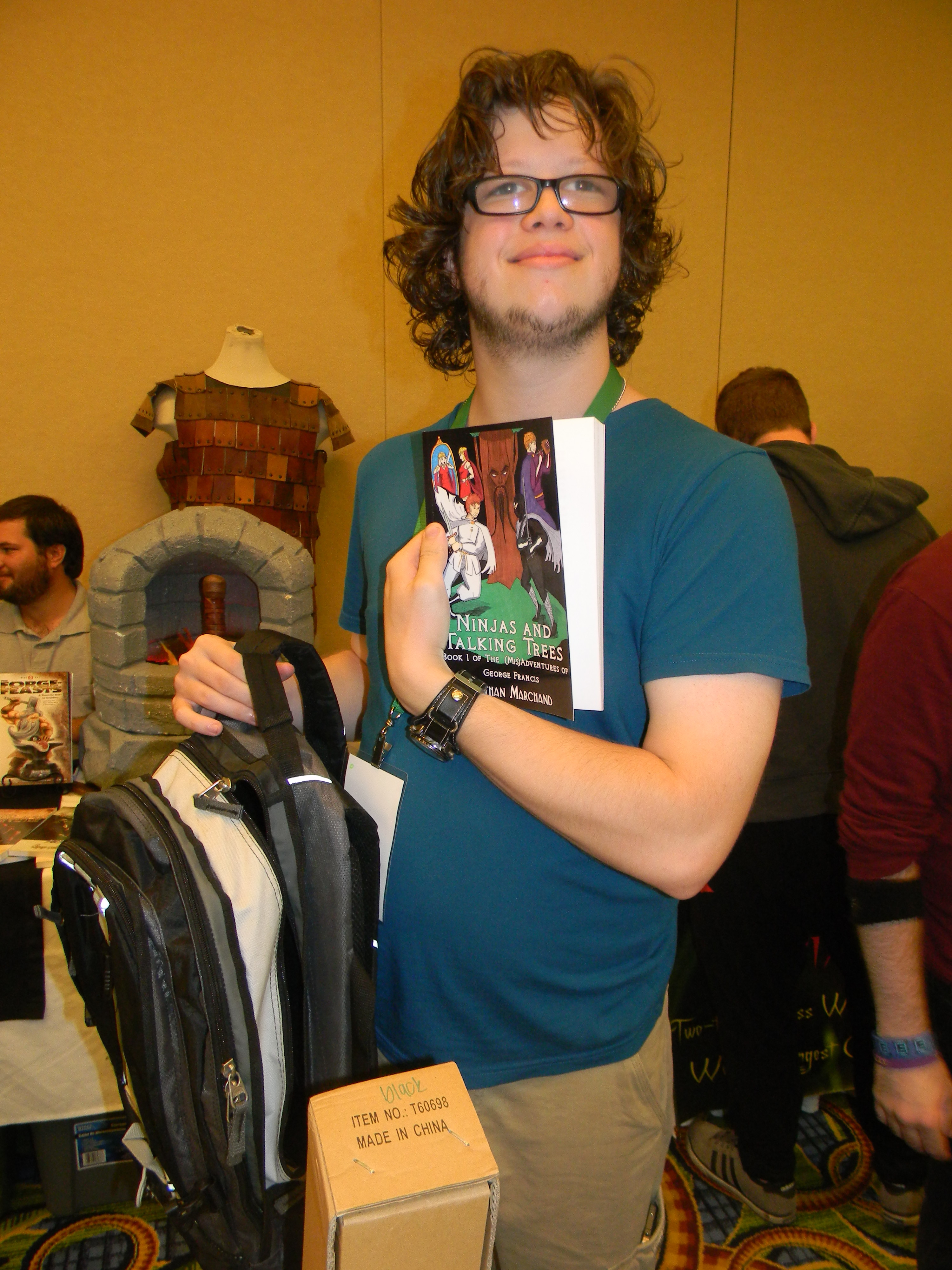
I did manage a few sales that day. Here are photos of my first buyers (I regret I lost my note with their names. Sorry!):

DSCN9321 DSCN9323

As usual, I explored the convention and checked out the evening events. I quickly learned that this was a party con. I think I saw more drunk people during the three days of this small convention (400-500 in attendance, at most) than I did all four days of Gen-Con, which had 60,000 in attendance. One of the events I checked out briefly was a what I thought would be a concert, but it was more of a rave. Raves aren’t my thing, but I did take a few photos and videos of the dancers.

I left to check into my hotel room—courtesy of a friend of a friend—and ran into a woman I’d met in the dealer hall. She wanted to talk with me about some stuff. We ended up chatting for at least two hours about reconciling faith with fandom because she had concerns about her teenage son. She and her pre-teen daughter were the only Christians in her family, which made things even harder. I think that conversation was the most important one I had the entire weekend and was one of the biggest reasons God wanted me there. It was a miracle I was still awake since my energy drink had worn off.

I checked into the hotel room and met my roommates. They were a bit rough around the edges, but despite starting as strangers, we got along and became friends.

Day Two
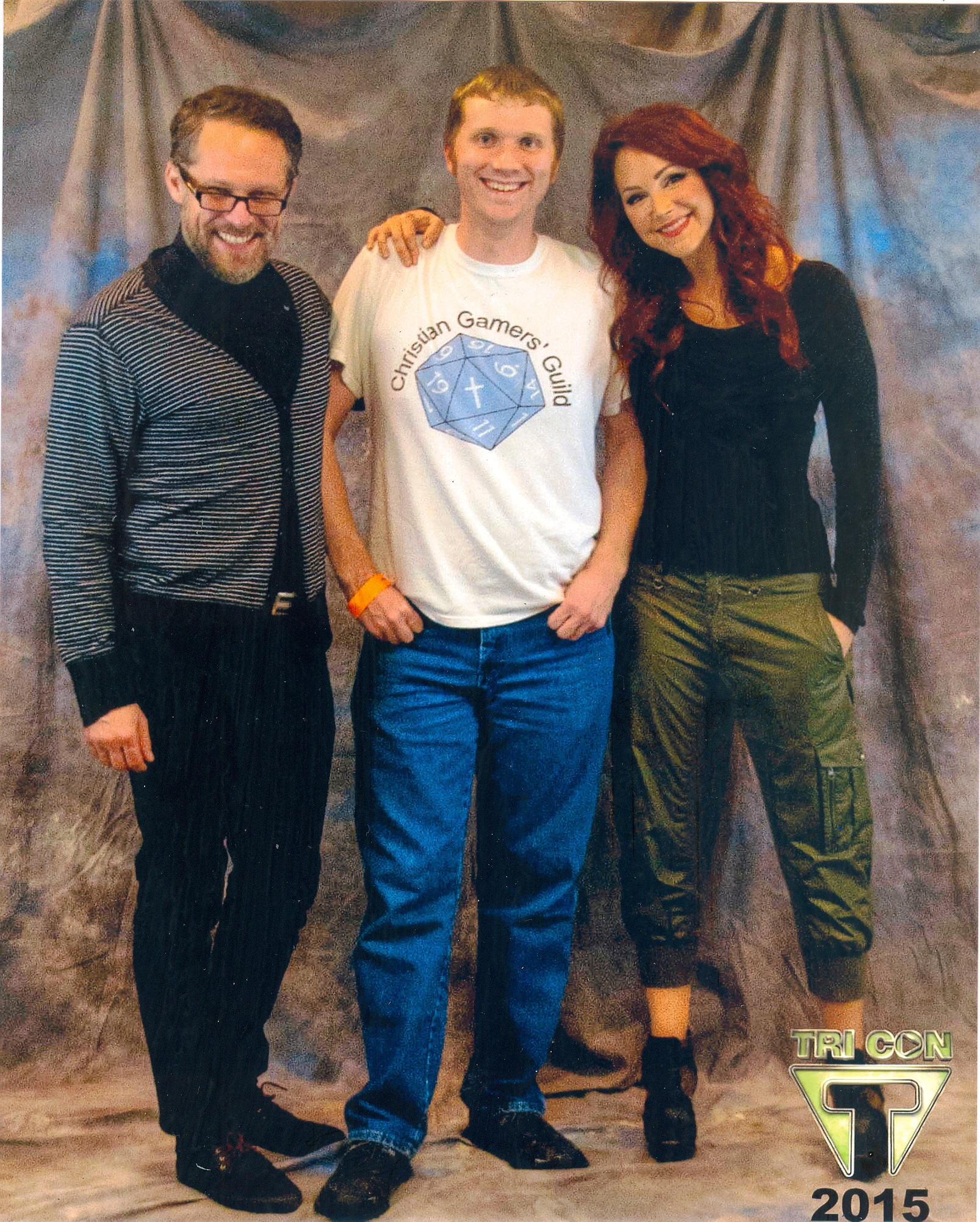
I slept in a bit since the dealer hall didn’t open until 11pm, I think. I took that opportunity to get a photo-op with Michele Specht and Chuck Huber who, among other things, are cast members from the fan-created series Star Trek Continues. Both were enthusiastic about their work, especially Michele. My gosh! And people think I’m crazy on caffeine. She’s a whirlwind!

Me with Chuck Huber and Michele Specht (who accidentally cosplayed Kim Possible).

I regretted not wearing my 10th Doctor costume on Saturday like I normally do since I missed some great photo-ops.

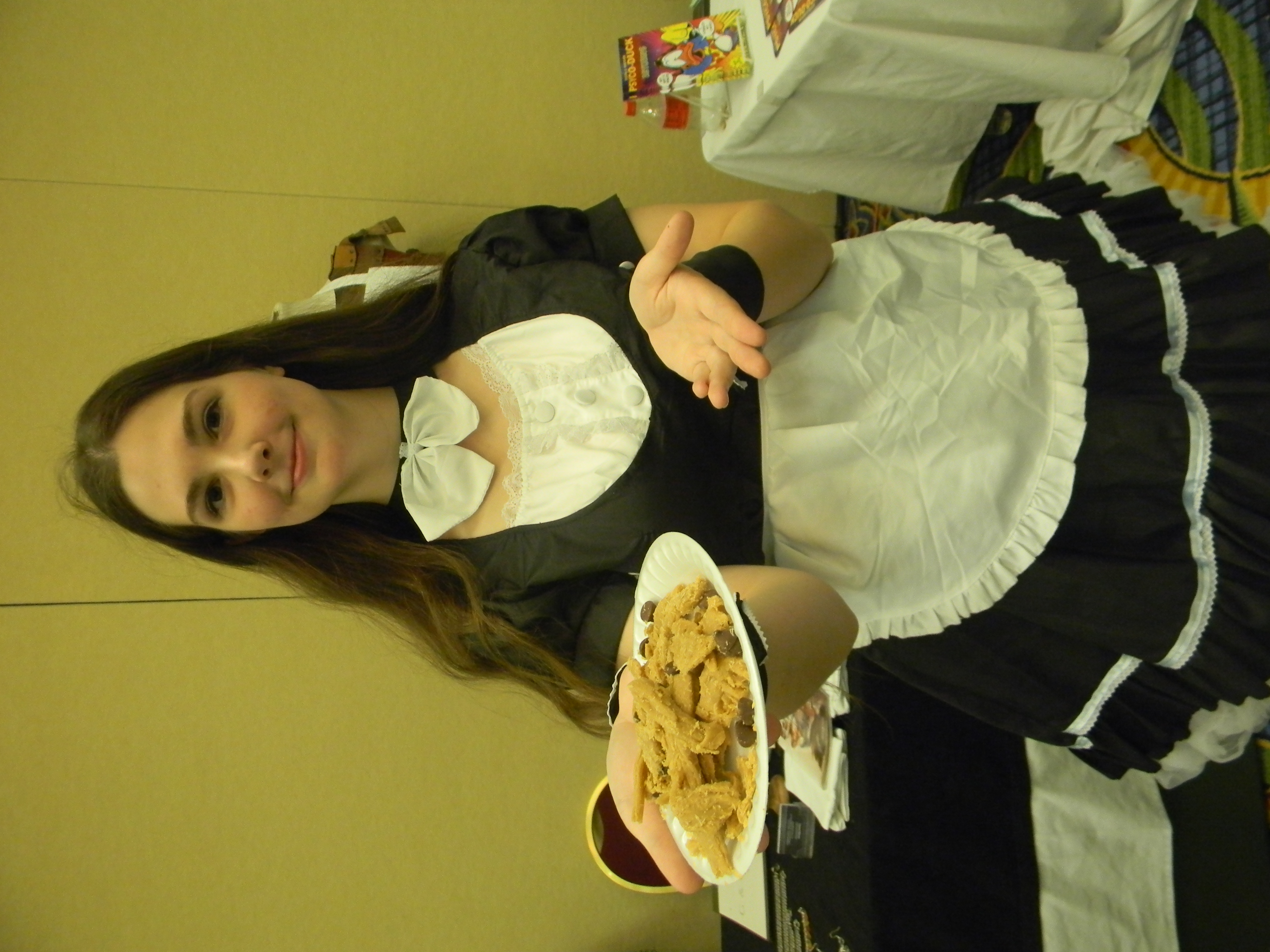
Maids Café waitress.

As for the vendor hall, it was shockingly slow. The most interesting thing that happened was one of the waitresses from the Maids Café came by and asked vendors for orders, so I got homemade Butterfingers. They were delicious! I made sure to tip her.

A attended the Star Trek Continues screening/panel, though I missed the screening. It was still great seeing Michele and Chuck interact with fans, though.

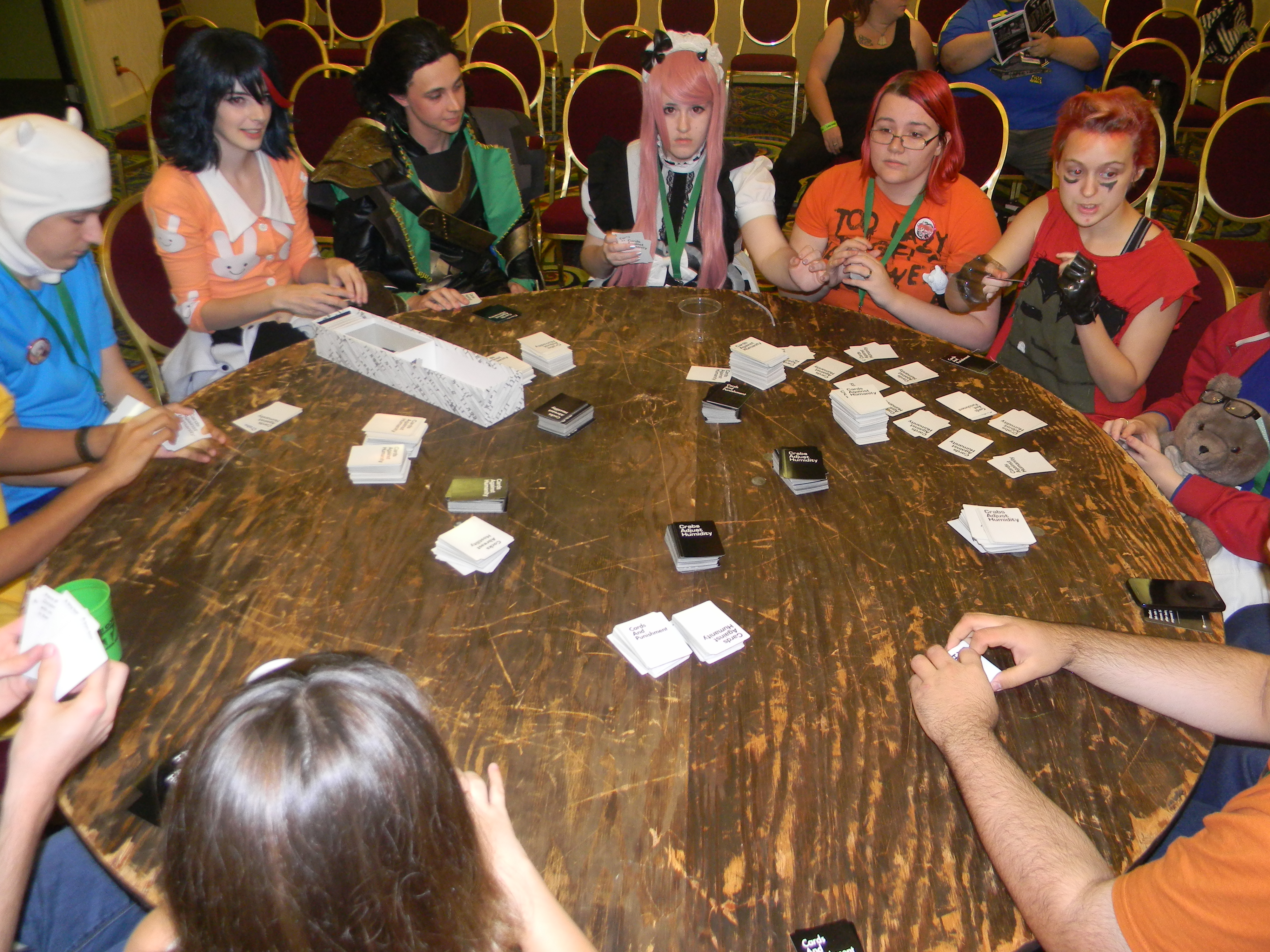
Loki winning at Cards Against Humanity.

The next event was another 21 and up party, so I skipped out on it. The alternative was an open play for Cards Against Humanity. I decided to watch before trying it, and I quickly learned it wasn’t the game for me (though I did make some great jokes while watching). I especially didn’t want to play when I saw Loki (a cosplayer) winning almost every round. He is Loki, after all.

Day Three
The last day of the con was one of the slowest, as you would imagine. I did wear my Doctor cosplay, but that was because I attended a “steampunk prayer service.” Only six or so people were there, but I still enjoyed it. It was presided over by an Anglican minister, so I got a taste of how that denomination conducted their services. It was educational. I gave the minister one of my business cards, and he came by later and bought a copy of 42: Discovering Faith Through Fandom.

My favorite photo of the weekend. You might be cool, but you'll never be the Doctor riding a speeder bike while sonic-ing his enemies cool. :P
My favorite photo of the weekend. You might be cool, but you’ll never be the Doctor riding a speeder bike while sonic-ing his enemies cool. 😛

When not in the dealer hall, I wandered around for some photo-ops. At 3pm, the vendor hall closed an hour before the con did, which was kinda weird. After packing up and saying goodbye to all my friends, new and old, I began the five-hour drive home.

The 42 Challenge
If you’ve followed my social media, you’ll know that my 42 co-author Eric Anderson, founder of Nerd Chapel, was attending Grand-Con in Grand Rapids, Michigan, that weekend and challenged me to see who could sell more copies of our devotional book. The loser would buy the winner a board game expansion. I was probably a bit overconfident. Eric beat me 20-6. It helped he went to a larger con, but that’s not an excuse. I will make good on my promise and buy him a game.

I hope you enjoyed this report. You can watch my video on the con here.

Godspeed, readers!

But I Digress…, Episode 30 – My Review of ‘Terminator: Genisys’

“But I Digress…”
Hosted by Nathan Marchand
After another long, unintended hiatus, I return with a summer movie review–one that left me with the most nerd rage I’ve had in a long time! The “Terminator” franchise, which includes some of my favorite films, has been “rebooted” stupidly. So much so, my old friend the T-800 returns to protect me from the new movie!
My text review of the movie for GIGA Geek Magazine.
My “Avengers: Age of Ultron” Review.
See the T-800’s original cameo here.
See the T-800’s first full appearance in Episode 8.
Please SUBSCRIBE, COMMENT, and SHARE!
Thank you for watching.