Tag Archives: nathan marchand

Another NEW BOOK: ‘Ninjas and Talking Trees’

I’m on a roll! (That was the correct “roll,” right?)

Actually, I just wanted to get another new book ready for Gen-Con 2015. Plus, this one has been sitting in my computer for a long time and needed to get into print.

So, without further ado, I present Ninjas and Talking Trees, which is book one of The (Mis)Adventures of George Francis.
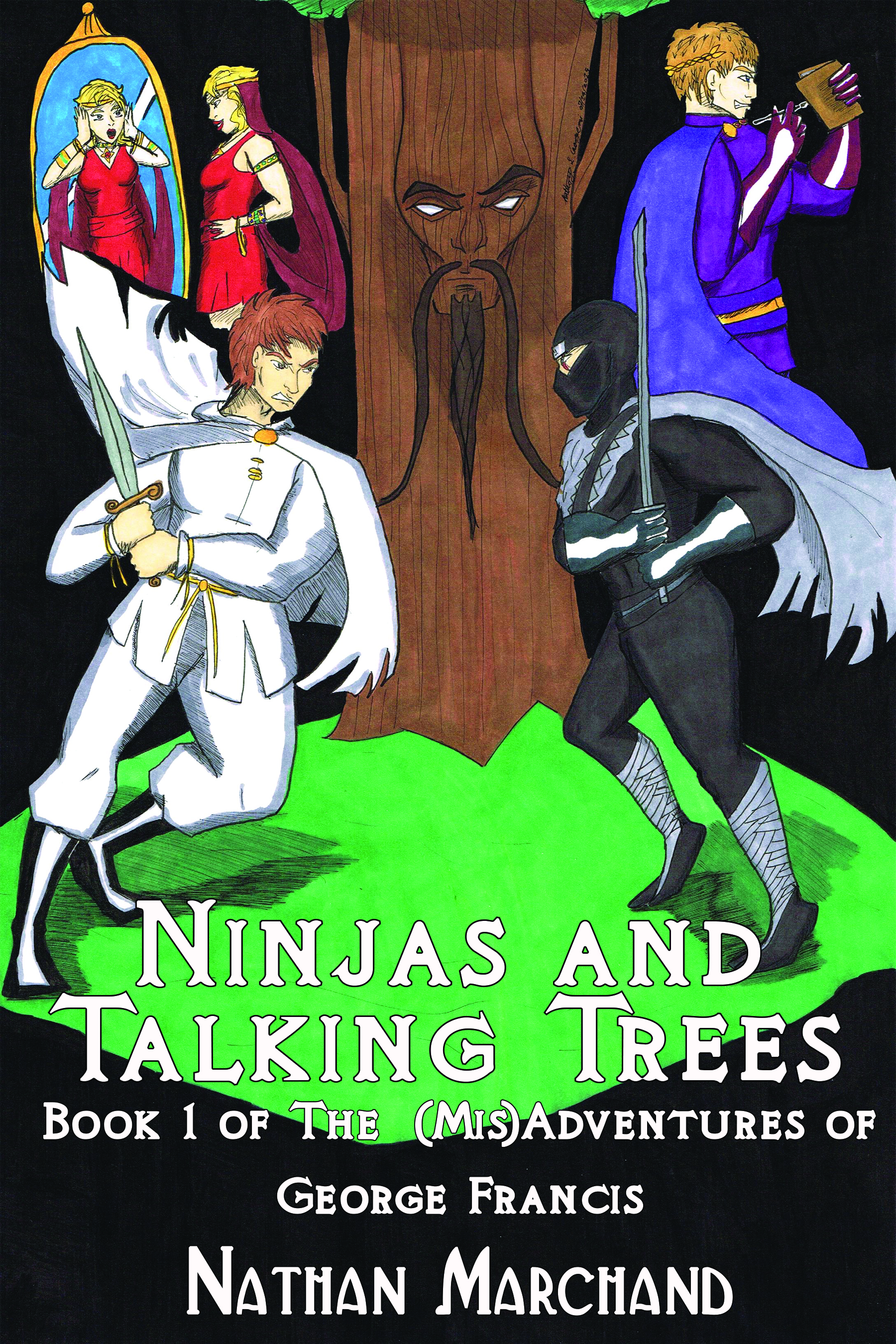
Cover art by Anthony Gangemi.

George Francis is a normal accountant in Fort Wayne, Indiana, who has it all: a disciplined routine, a great job, and a hot girlfriend named Destiny. Well, there are his uber-nerd college buddies, but they’re mostly harmless…until they met his Destiny. She dumps George immediately. They invite a heartbroken George to join them at a renaissance faire to make it up to him. But after entering a port-a-potty to soothe his aching stomach, George is transported to the world of Loconia and chased by ninjas.

Soon George meets Sensei, a Talking Tree who was once a samurai. He insists George is the “Hero of Legend,” and it’s his new destiny to liberate Loconia from the eccentric tyrant Marcus the Morally-Dubious in order to return home. George must survive Sensei’s grueling training (which includes dueling a samurai banzai tree) and then rescue Princess Pansy/Roze, who’s been cursed with a split personality—one good, one evil—that switches whenever someone snaps his fingers. To complicate matters, the good one is in love with George and the evil one plans to marry Marcus.

But George isn’t alone. He recruits Loconia’s bravest and finest to battle Marcus’ Legions of Terror: an unknowingly hapless pretty boy; an inarticulate Barbarian carrying a well-spoken ax; and a redneck wizard whose spells work better when he’s drunk.

Oh snap!

Will George’s sanity survive? Will he become the Hero of Legend? Will you stop reading this back cover and open the book to find out? (Just don’t skip to the end, you cheater!)

This book has an origin that’s just as humorous. During my last semester at Taylor University Fort Wayne, I took a class on C.S. Lewis and George McDonald that was taught by Dr. Pam Jordan-Long. One of the books we read was Phantastes by McDonald. A classmate told me before class that he thought it was a bit slow in middle and joked that it would’ve been better if ninjas were in it. But he didn’t stop there—he said that in class, too! Since Phantastes featured talking trees, we concluded as a class that all good stories must include ninjas and talking trees. It quickly became a prominent inside joke in the class for the rest of the semester. Even the normally serious Dr. Jordan-Long enjoyed it so much she put it on the final exam.

I decided then that since I couldn’t find any stories that featured both, I would write one myself. Since I’d just written Pandora’s Box, I decided I would do something completely different to avoid being pigeonholed as a writer, so I decided to write a fantasy/comedy. As the years went on, I collected many ideas for the book. Too many, in fact, for one book, which is why I’ve decided to make I a series. Essentially, it’s become a repository for my eccentric, absurdist sense of humor. You’ll see shades of Monty Python, Hitchhiker’s Guide to the Galaxy, and The Princess Bride, among other things, in it.

There’s more I could say about the book, but I’ll save that for another blog. This one’s long enough as it is.

Get your paperback copy of Ninjas and Talking Trees today on Amazon for $14.99! (EBook coming soon!)
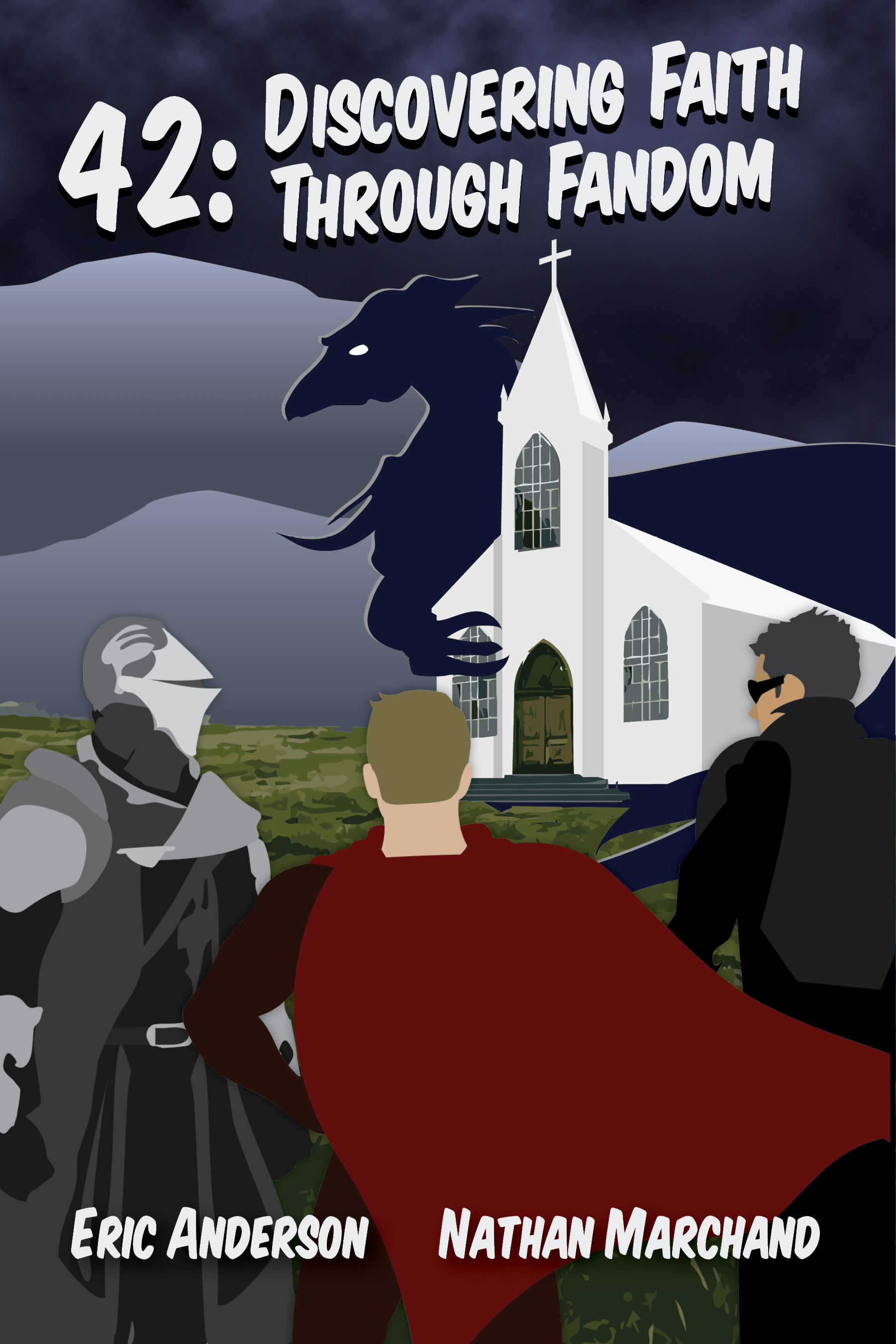
NEW BOOK: ’42: Discovering Faith Through Fandom’

Remember when I said I’d write two blogs in one week to make up for not writing? Yeah, that didn’t happen. In the words of the 10th Doctor, “I’m sorry. I’m so, so sorry.”

But I have a good reason for my unintended hiatus: I’ve been working on two new books! The first of which is now available on Amazon!

Presenting…

Artwork by Ruth Pike.

This little book is a devotional for geeks and nerds. It uses the stories, hobbies, and other interests nerds and geeks love to illustrate theological Truth.

Here’s the back cover copy:

Don’t Panic!

Despite what many churchgoers say, God doesn’t think Dungeons & Dragons is “Satan’s game” or that cosplay is childish. In fact, God has imprinted Himself into nerd culture. Yes, all your favorite stories and games point to the LORD Himself. You may doubt, but you know your nerdy hobbies are more than just escapism. They resound with you for a reason. Perhaps you’re not sure why, but they do. Regardless of your spiritual beliefs, there are profound truths to be mined from those tales.

Join us on a 42-day journey of discovery. Why 42? A famous “Guide” would have you believe that’s “the Answer to Life, the Universe, and Everything.” The trouble is you have to know “the Question.” Maybe that question for you is, “How many days will it take me to learn the Truth?” Or maybe you already know the true “Answer” but want to deepen your faith. Either way, this book is for you! We promise it’ll be fun and challenging. You may never look at your favorite stories, characters, and/or hobbies the same again.

Don’t forget your towel!

It was co-authored by myself and my friend Eric Anderson, the founder of Nerd Chapel. We each took turns writing the 500-800 word devotions for each day. We both bring our unique voices and styles to the book. We mine Truth from things like Star Trek, Star Wars, Doctor Who, G.I.Joe, and even a strange scientific discovery about water crystals!

As I said, the book is available on Amazon for $7.99. Get your copy today!

But I Digress…, Episode 29: How to Write Speculative Fiction, Part 4 – Major Subgenres of Sci-Fi

“But I Digress…”
Hosted by Nathan Marchand

After an unintended hiatus, I, Nathan Marchand, return with a proper episode! I conclude my four-part series–finally–on writing speculative fiction. Part 3 detailed the major subgenres of fantasy, and this episode does the same for science fiction.

What’d you think? Leave comments below!

Title card by Jarod Marchand.

The previous episodes:
Part 1
Part 2
Part 3

Please comment, subscribe, and share!

Daredevil and Writing Christian Characters

Matt Murdock (aka Daredevil) as seen in the new Netflix series. Played by Charlie Cox.

A few weeks ago, Marvel Comics released the 13-episode series Daredevil on Netflix. My longtime readers won’t be surprised when I say that it was this show–the first of five that Marvel is releasing exclusively to the streaming service–that made me finally sign up for Netflix. I’ve made it no secret that I love superheroes, comic books, and the Marvel Cinematic Universe.

(If you’d like to read my official review of the series, go to my Examiner page here).

One of the things I find most interesting about Daredevil is he is one of only a few Christian superheroes that I know of (Nightcrawler from X-Men is another). He’s Catholic, to be specific. I was curious to see how his faith would be handled in this series since Hollywood has a track record for presenting Christians as hypocrites, loons, or both. I thought they might gloss over his faith, at best.

I was pleasantly surprised to see that his faith was an integral part of his character. He unabashedly identifies himself as Catholic, even saying that it’s what keeps him going most of the time. But most importantly, his faith isn’t simplified. In fact, it makes him a complicated character. Conversely, he’s not the squeaky-clean, nigh-perfect Christian character usually presented in faith-based movies.

(WARNING: SPOILERS AHEAD!)

Matt has endured much tragedy. He was blinded as a boy after shoving a man out the way of a truck, which then accidentally dumped chemicals on him. His father, a mediocre boxer, was murdered by mobsters because he refused to throw a fight. He spent the next several years in a Catholic orphanage dealing with his radar-like super-senses (a “gift” of the chemical bath) until he was trained to fight by a skilled but amoral blind old man, who eventually abandoned him. Is it any wonder he adopted the faith of the orphanage? He needed it to go on. It spurred him to become a lawyer so he could help clean up Hell’s Kitchen.

But Matt quickly learned the limitations of the law. He told the story of hearing a man in the next-door apartment sexually molesting his eight-year-old daughter. Because of his super-senses, he was the only one who knew about it. The mother didn’t believe it, and, as he said, the father was “smart” and managed to convince Child Protective Services he was innocent. So, one night, having gotten sick of it, he put on a mask, tracked the father down, and beat him up, threatening to make the next one worse if he ever touched his daughter again. “I could sleep better after that,” he said.

This was his first night as a vigilante, which by definition is someone who operates outside the law to enforce some form of justice. It goes counter to what Matt normally would stand for as a lawyer. Yet it doesn’t. As Matt states in a courtroom speech, the law concerns itself with facts and not necessarily truth. It can only act based on the evidence that is presented. Plus, as Matt learns while trying to take down his archenemy Wilson Fisk (aka Kingpin), cops and judges can be bought or bullied to offer criminals protection. This brought Matt to a crossroads. The only way to stop Fisk seemed to be killing him, but as he confessed to his priest, such an act would damn his soul. This was only one of the many spiritual struggles he had concerning the morality of the often brutal tactics he used to enforce his vigilante justice.

What was brilliant about it was it all seemed realistic and believable. I’ve heard of many people in real life who’ve wrestled with huge moral issues (though, admittedly, they weren’t costumes vigilantes…so far as I know…). At one point Matt was willing to risk damning his soul if it meant saving his city. Ultimately, he found another way, but it may not be the perfect solution (that’ll be revealed in season 2). This struggle is presented with great respect. The show’s creators remember that religion is a large part of many people’s lives. It shouldn’t be mocked or ignored. (I also admit that putting characters in moral dilemmas is something I enjoy and used to do a lot in my own stories).

On the other hand, Matt would probably be criticized by many Christians (and perhaps fellow Catholics) because he isn’t perfect. Besides his questions of morality, he has (small?) vices like swearing and possibly pre-marital sex (it’s never shown and details aren’t offered, so the audience is left to decide). Yet at no point did I question the authenticity of his faith. It reminded me that things like cussing don’t always mean a religious person has a weak or superficial faith. Legalism never helps anyone.

What do you think? Did you see the series? How should Christian characters be written in fiction?

The Lost Digression: King of the Nerds Audition

Back in 2013, a friend told me that the show King of the Nerds was accepting video auditions for the second season, so he suggested I enter. I put together what I thought was a great video, but when I tried to post it, I learned I’d missed the submission deadline. So, this video has been stashed away on my hard drive since then and only recently did I remember it. I decided I’d post it just for the heck of it. Enjoy!

What’d you think? Could I have gotten on the show?

Please subscribe, comment, and share!

Well-Rounded or One-Dimensional?

As a teen and young adult, I used to regularly read Focus on the Family’s Plugged In magazine. Recently I checked out their review on the film Fury, which I’d recently seen. It can be summarized with these paragraphs:

Some will see that unflinching glimpse at perpetual bloodshed and gray-smoking destruction as something of an antiwar declaration. They’ll see a cautionary tale of men hollowed out and broken by the unspeakable horrors they’ve witnessed.

Others will see this pic as a one-dimensional splatter-fest dressed up in khaki Army fatigues, with limbs innumerable being severed by large-caliber machine gun fire and mortar rounds in a story of brutal, hard-fisted soldiers battling a Nazi evil even more wicked than themselves.

“Did you watch the same movie I did?” I asked.

In case you don’t know, Fury is a WWII film released last fall that stars Brad Pitt and Shia LeBeouf. It’s about a greenhorn Army clerk who ends up on the frontlines with a battle-hardened tank crew and sees firsthand the horrors of war, which makes him more willing to kill the enemy. I read Plugged In’s review because I wanted to see what they thought of Shia LeBeouf’s character, who is a Christian. (LeBeouf reportedly became a Christian during filming). Unsurprisingly, they complained about him, saying, “We see him praying over a wounded soldier and quoting Scripture several times before battle. That said, his faith doesn’t keep Bible from being every bit as foulmouthed, boozy and death-dealing as the rest of his crew.”

“What would you have preferred?” I asked. “That he fit the equally one-dimensional perfect or nigh-perfect stereotypes that populate ‘Christian’ films?” Besides, he swears much less than his compatriots and I only saw him drink alcohol once (and he didn’t get drunk, which is what the Bible condemns, not the consumption of alcohol). When his buddies make crude comments about German women, he rebuffs them. When they harass a German woman, he doesn’t participate. He’s not perfect. No Christian is. But he’s also not the typical religious loon usually seen in Hollywood films.

They also presented Pitt’s character “Wardaddy” as a one-dimensional, jingoistic jarhead you typically see in bad action movies. That more than anything baffled me. I saw a character who in many writers’ hand would’ve been exactly that, but both the script and Pitt’s performance add layers of nuance to him. He’s a man who will shoot an unarmed POW in the back and a few scenes later protect two young German women from his horny subordinates. When he walked into the women’s apartment, I fully expected him to do something terrible to them. But he didn’t. He does encourage the new recruit to sleep with the younger woman (which isn’t shown, so it’s debatable if they did anything). When they walk out he tells the young guy “nothing needs to be said.” But his defining characteristic is his desire to keep his men alive. Yes, he’s a borderline psychopath and possibly mad, but he’ll do whatever it takes to save his men. They respect him for that. He’s a complicated character. I was enthralled by this.

Not only was I bothered by this magazine’s overly biased review, it reminded me of the challenge writers have creating characters. What’s the difference between a well-rounded character and an inconsistent character? The line between them seems fuzzy. A common trait of bad writing is having a character act, well, out of character. For example, it’d be out of character for a patriotic superhero like Captain America to suddenly become a communist. On the other hand, people are full of contradictions. Hardened criminals in prison will abuse child rapists because despite their depravity, they have enough moral fiber to know not to do unspeakable things to children.

Dinobot from Beast Wars.

This is why my favorite character from Beast Wars (a childhood favorite cartoon) is Dinobot. He’s easily the best-written character in the show because of how complicated he is. He’s too honorable to be a bad guy but too rough to be a good guy. He’ll pull an opponent from cliff edge if said opponent slipped, but he has no qualms with throwing him off the cliff during combat. He defected from the bad guys but considered betraying the good guys later. Yet all of this fit his character.

Kenneth Branagh as Hamlet.

A more literary (and nebulous) example is Hamlet. Talk about complicated! I haven’t the time or space to adequately examine him. All I will say is he is a man who has a strong sense of justice and strong moral convictions. He believes his uncle is a murderer who should die, but he hesitates to kill him because of that same moral compunction against murder. (I don’t subscribe to the theory that Hamlet was insane). That’s one of many reasons why Shakespeare’s Hamlet is considered to be one of the greatest pieces of literature in the history of the world: the titular character is nuanced, complex, and seemingly contradictory.

Writing characters like this is hard. This is why many writers prefer static, two-dimensional characters. That isn’t to say such characters are inherently bad. There are plenty of great examples out there. But even they must act in ways consistent with their character.

What do you think is/are the difference(s) between well-rounded and inconsistent characters?

Intro Video/Trailer for my YouTube Channel

I just thought I’d share this. Enjoy!

Hello! I’m Nathan Marchand, author and YouTube host. Here’s a little video introducing my show and channel.

Looking for a little entertainment and/or instruction? Curious to hear my opinion on the newest books and movies? Then check out “But I Digress…,” my vlog (or video podcast or whatever people call it these days). Leave comments and join the discussion. Have ideas for future episodes? Send them my way. Want to catch the video ASAP? Subscribe to my YouTube Channel!

Featuring the music “Mega Man 2 Medley” from the new Super Smash Bros.

I’d Rather be a Trendsetter (or “Do I Have a Fanbase?”)

I wish I had numbers this good.

Sometimes looking at the numbers is discouraging.

Since my last few YouTube videos have been somewhat controversial troll magnets, I decided to check their statistics. While one has close to 3,000 views (it’s since slowed down because it’s designated as “unlisted”), the average amount of time the 12-minute video was viewed was two minutes. (In fact, that was the average for almost all of my videos). In other words, it’s been viewed many times but not often finished (and yet garnered such hate—I guess that’s an accomplishment). 😛 On the other hand, most of my other videos have only a few hundred views, at best.

I could look at this two ways: 1) I’m not as good as making videos as I thought, or 2) people on YouTube have super-short attention spans and get bored more easily than most. The former puts the blame on me and the latter puts the blame on the audience. Honestly, I’m not sure which is true.

Writers aren’t much without readers. They need a fanbase in order to make a living. The problem is building one. Fans are notoriously fickle, particularly in the speculative fiction realm. Striking a balance between giving them what they think they want and what they (or the stories) need is a tightrope act that’d scare most acrobats. I’ve been told by a few publishers and agents that the stories I submitted to them were “well-written” and that I had talent, but what I wrote wasn’t “trendy.” This annoys me. I’ve rarely, if ever, been one to follow trends. I’d rather be a trendsetter. I have far more respect for authors who dream up fresh ideas as opposed to trying to become the next J.R.R. Tolkien, J.K. Rowling, or Stephanie Meyer (God help us if any writers try to become the next E.L. James…). My English professor, Dr. Dennis E. Hensley, always told his students to be themselves as writers instead of watered down versions of other writers.

People sometimes ask me how many copies of my books have sold. I honestly don’t know. I once asked my publisher a few years ago how many copies of Pandora’s Box had sold, but I was disappointed with the numbers so I haven’t asked since. I’m not expecting it to be a New York Times bestseller, but I do hope some people are buying it and enjoying it. While I know number of copies sold and video view counts aren’t necessarily indications of quality, they can be indications of how well the creator is reaching his audience.

Regardless, when I hear people describe themselves as a “fan” of me, I’m surprised. Hopefully someday that won’t be such a shock anymore.

Fellow creators, what do you do to build your fanbase?

Digression 11: My Tribute to Leonard Nimoy

I reflect on how much impact the legendary Leonard Nimoy has had on my life. He was an amazing man and will be greatly missed by the geek community.

I’ll never be able to watch Spock’s death and funeral from “Star Trek II: The Wrath of the Khan” the same way ever again.

(Featuring the music track “Amazing Grace” by James Horner).

Representation in Stories is Overrated

Marvel Comics recently announced it was launching a new title with an all-female Avengers team called A-Force. It seems like it will feature many of the House of Ideas’ most famous superheroines—like She-Hulk, Black Widow, and Phoenix—many of whom have been members of the main Avengers team.

I’m not opposed to this idea in concept. If Marvel thinks they can generate good stories with a team like this, I’m all for it. The problem, I think, is that doesn’t seem to be their motivation. This reeks of political correctness. It’s an attempt at “diversifying” their titles because they think it’ll appeal to a wider audience. (Ironic considering this team technically isn’t diverse because it has no men on it).

The comic book industry has been dominated by men since its inception. Generally speaking, male authors write male protagonists because they’re drawing upon their own experiences as a male. Now, that doesn’t mean they haven’t written any female characters well. I’d argue there are plenty out there. Unfortunately, comics have a reputation for presenting those characters as sexual objects. Some of it is deserved, but I’d say some of it isn’t. It depends on the individual creators, companies, and/or eras. Regardless, my point remains that it’s understandable that superheroines are a minority in comics because most creators are male (and that’s not a bad thing).

This comic, whether it’s good or not, seems like it’s based on the notion that particular demographics won’t enjoy a story unless the protagonists share their gender, ethnicity, religion, and/or whatnot. In this case, they could be assuming that women won’t read the regular Avengers titles because there are only a few women on the team at any given time (in the first movie, there was only one). This extends to other demographics (i.e. only black people will enjoy stories featuring black characters).

I reject this idea. I’m sure it’s true for some people, but I don’t think most audiences care. What I look for is a good story with characters I like and/or identify with. This goes way beyond skin color or reproductive organs. A truly great story is one that focuses on human experiences, which transcend those outward superficial differences. I read/watch The Hunger Games because it has a good story; the protagonist’s gender had little or no effect on my enjoyment. Everyone has dealt with stuff like trauma, pain, joy, love, and rejection. Those things aren’t a respecter of persons, whether they be fictional or real.

One of my favorite characters in the Star Trek franchise is Benjamin Sisko from Deep Space Nine. Obviously, he’s a black man. But guess what? I never notice. What do I notice? His soft-spoken demeanor, his furious temper, his love for his son, and the pain of losing his wife in battle. All universally human experiences. Read this excerpt from the show’s bible that describes the character. Nowhere does it mention his ethnicity. It was only brought up in the show when it was necessary. That’s how it should always be handled. A character’s ethnicity, gender, and/or religious beliefs can be used to create drama (or comedy), but it shouldn’t define them. It’s only a small part of who they are. Trying to base the character around those traits will, in fact, alienate audiences.

Adding arbitrary diversity also hampers stories. Case in point: Tauriel in Peter Jackson’s Hobbit films. She’s not from the book or any of J.R.R. Tolkien’s Lord of the Rings canon. She was created by Jackson and his wife, Fran, because they wanted to add a woman to the almost all-male cast in the hopes of attracting a female audience. She’s completely extraneous to the story. What little purpose she has is to serve as one point in an unnecessary love triangle between her, Kili, and Legolas (who also wasn’t in the book, but I’m willing to accept him here because it’s arguable he was one of the Elves in the story). In other words, Jackson seems to think women want to see cliché “love stories” that go nowhere. Tauriel might be an okay character in concept, but ultimately she’s just part of what amounts a big-budget fanfiction. Instead, Jackson should’ve focused on Bilbo’s growth, which anyone can identify with. Stories don’t need to have romance to be appealing to women.

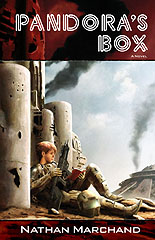
Pandora-155w-100dpi-C8In the very early stages of writing my first novel, Pandora’s Box, I thought the protagonist would be male. But as the story progressed, I realized it’d be better if the “hero” was actually a heroine. By doing that, I believe I made the story much stronger and more interesting. I didn’t do it to broaden (or narrow) it’s appeal or make some sort of statement—I did it because it was what the story needed. That’s why one of my author mantras is, “Story is king.” Whatever my tale needs, I give it. If it’s a female protagonist, then a female protagonist. If it’s a German scientist, then a German scientist. If it’s a trope-tastic ninja, then a trope-tastic ninja. 😛

So, if you’re concerned with having diversity in your story, don’t bother unless it’ll serve it well. Focus instead on telling as good of a story as you can. That will get you an audience from all races, colors, and creeds.